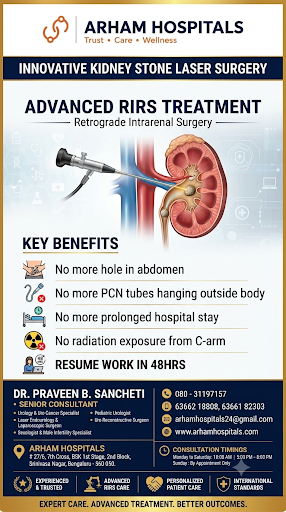
During RIRS, a thin flexible ureteroscope is passed through the urethra, bladder and ureter into…
During RIRS, a thin flexible ureteroscope is passed through the urethra, bladder and ureter into the kidney. A laser is then used to fragment the stone into small pieces or fine dust, which can either be removed or passed naturally in the urine. A temporary DJ stent may be placed depending on the size and location of the stone and the condition of the ureter.
Advantages of RIRS
- No external incision in most cases
- Minimally invasive treatment
- Effective for many kidney and upper ureteric stones
- Reduced postoperative discomfort compared with some conventional procedures
- Short hospital stay in appropriately selected patients
- Faster return to routine activities
- Useful for stones in difficult-to-reach areas of the kidney
RIRS is particularly useful for appropriately selected renal stones, including stones that may be difficult to treat with other techniques. The choice of treatment depends on stone size, location, number, kidney anatomy, previous procedures and overall patient health.
Recovery Most patients can return to routine activities relatively quickly, depending on the procedure and individual recovery.