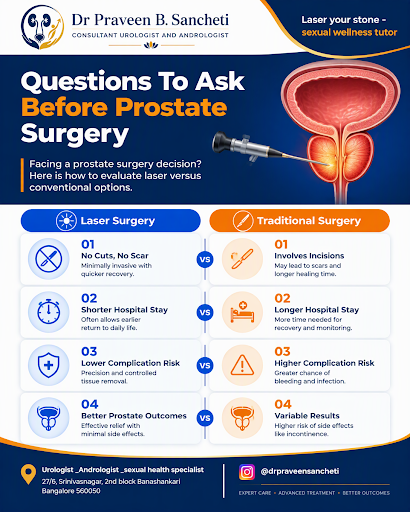
Patient information guide | Enlarged prostate (BPH) and prostate cancer
Published
Before undergoing prostate surgery, patients should understand the reason for surgery, available treatment options, possible complications, sexual function, recovery time and long-term outcomes.
1. Diagnosis and need for surgery
- What is my diagnosis — enlarged prostate (BPH) or prostate cancer?
- What is my prostate size in grams or cc?
- What are my PSA, uroflowmetry and post-void residual urine results?
- Is surgery necessary, or can medication and observation help?
- What are the risks of delaying surgery?
- Has my bladder function been affected by the enlarged prostate?
- Do I need any additional tests before surgery?
2. Choosing the right surgical procedure
- Which procedure is best for me — TURP, HoLEP, ThuLEP or another technique?
- Why do you recommend this procedure over other options?
- Am I suitable for laser prostate surgery?
- How experienced is the surgeon with this procedure?
- What are the chances of needing repeat surgery?
- Will the removed prostate tissue be sent for histopathological examination?
- How much improvement in urinary symptoms can I expect?
3. Risks and possible complications
* What are the common and serious complications? * What is the risk of bleeding or requiring a blood transfusion? * Can I develop urinary incontinence or difficulty passing urine? * What is the risk of urethral stricture or bladder-neck contracture? *